Tuesday, September 23, 2014

An Epic Quest Coming Soon: The L.A. Odyssey Project

From the Library Foundation's Fifth & Flower blog:

"Almost every reader has some kinship with the archetypal characters and situations thatThe Odyssey represents, and this October, the Library Foundation of Los Angeles and the Los Angeles Public Library invite readers across the city to rethink one of literature’s classic and heroic stories: The Odyssey. Throughout the month, the Foundation and Library will present The L.A. Odyssey Project, a month-long city-wide quest to consider what Homer’s epic tale of adventure and endurance means to Los Angeles readers today.


In honor of the oral tradition that allowed Homer to capture the story in writing, the project will culminate on Saturday, October 25 with a seven-hour marathon recitation of the poemby the public at the Central Library."

Find the original post here: An Epic Quest Coming Soon: The L.A. Odyssey Project.

Thursday, September 26, 2013

The Cyrus Cylinder at the Villa

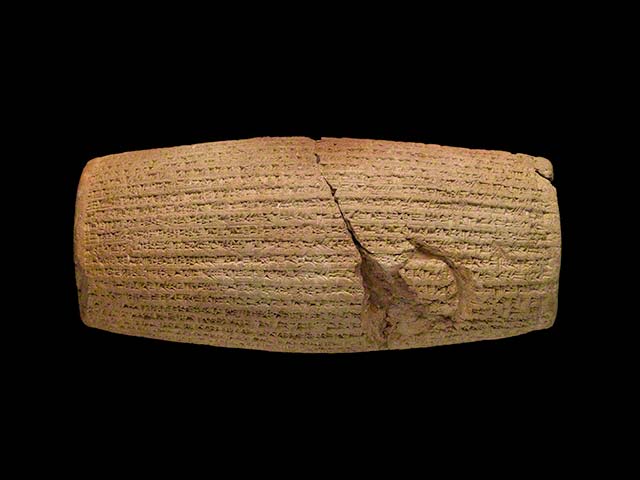
From 10/2 to 12/2, the famous "Cyrus Cylinder" will be on display at the Getty Villa, which records in cuneiform conquest of Babylon in 539 BCE by the Cyrus of Persia. We will be planning a trip to the Getty Villa for Saturday, 11/9 to see the cylinder and the rest of the collection.

The Cyrus Cylinder
For more information on the history of the cylinder and its cuneiform script, including a fascinating video on writing in cuneiform, read through the great post on the Getty's blog.

Friday, September 6, 2013

Thursday, August 29, 2013

JCL Club 2013-14

Welcome back to campus or, for those new to HW, welcoming to campus! I'm sure you all are as excited as we are for the new school year, and we're happy to announce that our JCL club meetings will resume on Tuesday, 9/10 in HC310. All are welcome to join the club and participate in our activities — Latin is not a prerequisite!

We have another exciting year of activities, including a fall trip to the Getty Villa (details forthcoming; cf. the video on the installation of the "Lion Attacking a Horse" exhibition below). Additionally, the CJCL state convention will be held on April 4-5 (the last weekend of spring break), so be sure to mark your calendars.


Best of luck with the new academic year, and we'll see you all very soon!

Saturday, August 24, 2013

Wednesday, July 31, 2013

Prometheus Bound at the Getty Villa

Coinciding perfectly with the start of the new academic year, the Getty Villa's fall "Outdoor Theater" series will feature Prometheus Bound (attributed to Aeschylus but not without problems). From the Villa:
"The Titan Prometheus, progenitor and champion of humankind, has stolen fire from Mount Olympus, giving rise to human civilization. As punishment, he is doomed by Zeus to spend eternity chained to a mountaintop, where Prometheus rails against the gods and all the world's injustices. Witness the timeless tragedy—and victory—of the prisoner who refuses to be silent in the face of tyranny."
The 90-minute performances will take place Thursday-Friday-Saturday at 8pm throughout the month of September, and tickets ($42) can be purchased here. It should be a fantastic spectacle, so be sure to get tickets quickly, since they will certainly sell out.

Prometheus Wheel installation, from the Getty Villa's Facebook page

Thursday, April 11, 2013

Sicily: Art and Invention between Greece and Rome


Over our spring break, the Getty Villa's exhibition Sicily: Art and Invention between Greece and Rome opened, which focuses on the life and culture of ancient Sicily from the 5th through 3rd c. BCE and will run through this summer to August 19.

Despite its title, the materials in the exhibition are primarily Sikeliote Greek, including some sculpture, unique pottery, rare coins, and a few other interesting pieces (e.g. the spectacular golden "Phiale of Achyris").

Of especial interest are the materials devoted to the Sicilian engineer Archimedes, including a page from a palimpsest recording his work on his famous stomachion problem ("Archimedes' square").  Novelty versions of the square are available in the Villa's gift shop.

Poppies
The exhibition is organized thematically, with features on the island's initial colonization by the Greeks, its literary culture, and its religion (focusing, of course, on Demeter).  The materials on literature and art are particularly interesting, given that several prominent Greek literary figures like Pindar and Aeschylus, visited Sicily, leaving their mark on its culture.
Marigolds beside a fig tree

The Villa's side production for the exhibition, as is customary, is fantastic, and the exhibition catalog, which is designed to bridge the gap in scholarship in this period, is beautiful.

As an added bonus for visitors right now, several of the flowers in the Villa's several gardens are in bloom, making the Sikeliote art not the only attraction worth visiting.

The Latin program will sponsor a tour of the Getty Villa later this spring on Sunday, May 19 on behalf of the HWPA Partybook, and we'll certainly explore this exhibition in great detail.


Sunday, February 24, 2013

And the Oscar Goes to....

After much deliberation in this very difficult race, I am proud to announce that this year's JCL tshirt design is....


We'll order this shirt this week, and we should have plenty of time before the convention to show them off around campus.  Thanks to all of you for your input and passion for JCL fashion!

One other item of business:  in addition to the convention activities mentioned in the previous post, we'd like to remind you all that your Latin projects (including your Latin IB videos!) may be submitted for the Art Competitions detailed in the "White Booklet" (cf. pp. 24-25).

Friday, February 22, 2013

Convention Activities

It’s time to start thinking about what contests and activities you might want to participate in at the convention, beside the required Academic Tests.  For detailed information on all the contests and activities on offer, look here at the convention site.

If you want to organize a team for any of the following chapter contests, please let us know ASAP, because we need to pre-register:  Chariot, Catapult, Battle of the Bands, Team Gladiator Combat, Basketball, Dodgeball, Quidditch, Giant Jenga Jeopardy 


We encourage you all to sign up for contests/activities. Participating in them should make convention more fun.  Here are some you might want to consider:
  • Aeneid/Catullus Recitation (HS-Adv only)  For this contest, you memorize a passage of Latin and recite it for the judges. One of the Aeneid passages is arma virumque cano. The Catullus passage is Catullus 5 (vivamus mea Lesbia atque amemus). 
  • Latin Oratory  Memorize a passage of Cicero and recite it for the judges. Show off your public speaking skills. 
  • Roman Rant (English Oratory)  Compose a three-minute speech in English on any Roman-related topic or one that is connected to one of the convention themes. The speech does not have to be memorized. 
  • Latin Sight Reading  Recite a given passage of Latin, showing off your immaculate Latin pronunciation. You do not have to prepare anything beforehand for this contest. 

All the passages for the Academic Contests are available here on the convention website, and more information about the Art, Music and Sports contests can be found here.

Wednesday, February 13, 2013

Convention Announcement

Straight from the organizers of the convention themselves:

Jenga!
Gladiators!
"This year at State Convention we have many new and exciting things. We have members of a Roman Legion that will be there all day Saturday, giant jeopardy jenga, the 12 Labors of Hercules scavenger hunt, the Herculean Obstacle Course, and the assemblies have been spiced upped with drama, death, and the JCL creed and song have been put to the tunes of songs we all know and love. We also have Certamen, Catapults, Chariots, Latin Sight Readings, and the rest of the classics. The closing banquet will be amazing, with casino games, glow in the dark ping pong, and magician Lou Serrano, who has performed at Magic Castle. Here is the link to our website for more information, bewaretheides.net, or feel free to contact us back at sagejcl@gmail.com. We hope to see you at the Convention on March 15th and 16th."


We expect this convention to be one of the best and most "Caesarlicious", and there's now less than a week to sign up.  Do it now!


Tuesday, February 12, 2013

Sign up for the 2013 CJCL Convention!

Convention, affectionately know as "Latin Retreat", is almost here and will take place on the Ides of March this spring (March 15-16) at the Sage Hill School in Newport Coast!  We must register by next Tuesday, 2/19, which means that all forms and waivers must be completed by then.  Read through the convention letter and contact us with any questions about the trip.
To reserve a space on the trip, please be sure to complete the following steps:
  1. Submit your convention information using the trip registration form.  Let us know your tshirt size, roommate preference, etc.  You'll need to login using your HW name/password.
  2. Be sure to sign the student waiver on HW student portal, and have your parents sign the parent waiver too.  You cannot come on the trip without signatures on these two forms!
  3. Finally, be sure to complete the CJCL Delegate Registration form and the two-sided Medical Information and Waiver form.  Be sure to sign up for at least one academic test, and include any other activities you'd like to participate in.  Your choices are not binding, however.  Also consider submitting old Latin projects (e.g. houses, games, coins, vases, etc.) for select competitions.  These two forms must be turned in no later than Tuesday, 2/19.  
For more information about the convention in general, cf. the Sage Hill School's convention page, which includes detailed information about convention events.  We hope you can join us!

N.B.:  Financial aid is available for this trip.  Contact the Financial Aid Office with any questions.

Monday, January 21, 2013

The Hidden Classical World in Los Angeles

Though the Last Days of Pompeii exhibition has recently moved on from the Getty Villa (it's now at the Cleveland Museum of Art), there are other interesting pieces of art with connections to ancient Rome and Greece to be found in Los Angeles right now.  That items of this sort can be found almost randomly in Los Angeles goes to show just how pervasive Greco-Roman culture was in the ancient world and now, and it also attests to the fact that we live in a city remarkably rich in art.
Roman costume from Spartacus

The Stanley Kubrick exhibition at the Los Angeles County Museum of Art has materials from all of the director's work. Items from his 1960 film Spartacus are on display, including costumes and storyboards from the movie. The degree of detail that Kubrick put into his movies was extraordinary, and the small corner of the exhibition dedicated to this film provides a fascinating glimpse into how movies on ancient Rome were made in his time. The Kubrick exhibition runs through June 30, 2013.
The Art of Continuity at the Pacific Asia Museum 
The Pacific Art Museum in Pasadena currently has on display The Art of Continuity: Revering our Elders, which collects Asian traditions of revering and honoring ancestors.  It's worth visiting to compare the Asian traditions to the Roman mos maiorum, in that the values that both traditions had are similar in some interesting ways.  Revering our Elders is on display until Jan. 5, 2014.
Buddha Shakyamuni
Also in Pasadena, the Norton Simon Museum houses a remarkable collection of Asian art, including spectacular pieces of Buddhist art. One piece in particular, a statue of Buddha Shakyamuni from Gandhara dating to c. 200CE (pictured above), is remarkable for its multicultural features. The Buddha shows the classical hand mudra and ushnisha above his head. But because ancient Gandhara (modern Pakistan) was at a confluence of Greek and Asian culture, thanks to the conquest of Alexander the Great, much art from the region shows Greek influence. Here, the statue possesses a flowing gown and curled hair that are not characteristic of Buddha depictions in older Buddhist art, but rather are standard features belonging to Hellinistic sculpture. This Buddha is part of the Norton Simon's permanent collection. Interest in ancient Gandhara has been on the rise, and the Metropolitan Museum of Art in New York currently has a beautiful exhibition Buddhism art along the Silk Road through Feb. 10, 2013 that also includes several similar examples of Buddhist art with Hellenistic features.

Feel free to add any other potentially interesting items of Classical interest in the greater Los Angeles area below in the comments.

Thursday, December 13, 2012

Digital Classical Texts

In reading the Getty Museum's recent blog post about an ancient Greek curse tablet dating to about 100 BCE and found in Morgantina that's now on display at the Villa, I noticed in the post a link to a website devoted to curse texts from Roman Britain.  It's an excellent site worthy of use in Latin classrooms for multiple reasons, with several interesting curse texts that are fairly easy to read (if not strange), and it can now be placed beside the rest of the digital "Vindolanda" tablets, which are also available online.
Given the current push toward digital texts in classrooms, it seems like a good time to share other online resources for reading Latin with the goal of discovering others.  The gold standard, of course, is still the Perseus Project, but the Latin Library is also very useful.  A short list is given below:

Are there any other digital resources for Latin (or Greek!), including dictionaries, that Classics students have found interesting and useful?  Please comment, if so!

Wednesday, December 12, 2012

Convention Et Cetera

Now that the end of the calendar is approaching, it's time to start thinking about some of our spring activities, including the CA JCL convention, which will take place at the Sage Hill School on Friday, 3/15 (the Ides of March!) and Saturday, 3/16.  The school has put together a fantastic convention site and Facebook group page that are both worth exploring.
For those of you interested in playing competitive certamen at the convention, your team will need to qualify at CARCER, which will be held Saturday, 2/16 from 10am-2:30pm at the Willows Community School in Culver City.  All competitive certamen teams should plan on attending.
We've got two more extracurricular exams on the horizon:  the National Latin Exam during the week of March 11th and the Medusa Myth Exam during the week of March 18th.  Registration for both exams is due toward the end of Jan., so we'll start taking names for them after we return from the holiday break.  Enjoy it, and we'll see you all soon!

Monday, October 15, 2012

Vindolanda Mini-Class

I've been asked to teach a "mini"-class for prospective 7th graders at one of our schools Family Visit Days, when we'll host applicants.  The classes are broken down into 20-minute slots for no more than 20 students, and we'll run each class 6 times.  Thanks to the format, it's very difficult to teach a language-based mini-class, let alone one in Latin, but I have an idea that I'm eager to try.
I explored Hadrian's Wall a few years ago and have since been very interested in the military letters found along the wall, chiefly in the Roman fort at Vindolanda.  With that in mind, I've decided to do a very short writing project with the kids, having them write "Vindolanda" letters of their own.  I'll use Google Earth to "travel" to Hadrian's Wall and show them just how far they were from Rome (maybe also briefly using Stanford's ORBIS project?), then give them the Roman cursive script used along the wall and some Latin phrases in a Google Doc as a starting point.  They'll write their letters on a small piece of balsa wood using a black marker (cf. the famous letter 291 below), and I'll paste a QR code (found above) on the back of each "tablet" that will direct them to the same Google Doc, on which I'll allow comments, in case they have any questions or comments after they leave the classroom.  It'll be fun to see how many kids visit the Google Doc after the classes are over.
This project should be a great way to learn actively a little bit about the formalities of Roman letter writing, including names and dates, while working within an actual historical framework.  And it'll be a nice personal project that students will be able to take home with them.  I'm eagerly looking forward to putting some ideas I've had over the past few months to the test.

Tuesday, October 2, 2012

Greek Iconography Workshop Ideas

Right now I'm taking Google's Power Searching online course and am enjoying it.  In our 4th lesson, I learned that images can be dragged/dropped directly into the search bar for imaged searches (but not on tablet devices; cf. below!).  I got to thinking that this could be incredibly useful in looking at Greek iconography with students.  We offer the Medusa Mythology Exam as an optional exam to our students at the school, and I think we could have a lot of fun in a workshop combining the iconography of the mythic figures covered in the exam with the search tools we've learned in the course.  As an exercise, we could give students images from Greek vases or other pieces of art and ask them to identify the figures, based on what they see.  Then, they could check their guesses by searching for the image online and even figure out more about the image, e.g. its museum location, approximate date, etc.  Basically, it's an online scavenger hunt.
But, as noted in the course, image searching does not work with tablet devices!  Our school is in the beginning stages of implementing a 1:1 program starting next year, but we haven't yet chosen a device.  I'm sufficiently excited in the ability to search images in this way that I think this is another strong argument against adopting an iPad or other tablet device.  For now, I'm going to demo this myself in one of our JCL club meetings, but it's an idea I intend to explore in greater detail in the near future.

Medusa Mythology Exam


This year's theme for the 2013 Medusa Mythology Exam is The Trojan War:  Life and Death on Trojan Soil, and we'll plan on doing the exam sometime in March.  In the meantime, let's devote a JCL meeting in November or December to looking at the iconography of the figures in the exam syllabus as depicted on Greek vases and other works of art.  More information TBA!

Thursday, September 27, 2012

Cheating, Investment, and Technogogy

We are in the middle of a reassessment of our honor code and have been thinking about ways to make it more visible in our daily lives on campus.  With that in mind, I just read through this NYT article on cheating at Stuyvesant HS, and a few things struck me.  One of the students who admitted to cheating, blamed his academic dishonesty on his lack of respect for his French teacher; he asks, “When it came to French class, where the teacher had literally taught me nothing all year, and during the final the students around me were openly discussing the answers, should I not listen?”
I hate to admit this, but he has a point, at least in part.  This goes back to the issue of personal investment in an academic courses that I brought up a few days ago.  I think I undervalued the importance in student investment for preventing academic dishonesty:  to my mind, students are less likely to cheat in a course, if they have respect for the course, namely, for the instructor, the material, and especially their role as a student.  I can't help but think that if this student really enjoyed his French class and was personally interested in the material, he would have acted differently.  But I wonder if this is a naive view on my part, given the "make or break" attitudes toward college these days...?

Additionally, I found it stunning that the interim principal of Stuyvesant has banned the use of laptops and iPads on campus during the day, which goes directly against the "1:1" movement that many schools, including ours, are pushing.  I think I've undervalued the concern for cheating in pushing for more "technogogy" in schools and it's a concern I indeed want to address with faculty but I don't see how electronic prohibition will help to prevent cheating and facilitate us moving forward with technology.  Many of the methods outlined in the article had nothing to do with electronic devices, and students who are intent on cheating will always find a way.  So, the issue of academic dishonesty is something to keep an eye on, as we push forward with our 1:1 movement and curricula redesigns.

Wednesday, September 26, 2012

Fall Events at the Villa


Lots of great events are happening at the Getty Villa this fall, in addition to the Lion Attacking a Horse and The Last Days of Pompeii exhibitions.  Friday, 10/2 and Saturday, 10/3 the Villa will be screening two versions of the film The Last Days of Pompeii.  On Friday night at 7:30pm, the 1913 silent film will be shown, and on Saturday at 7:30pm the Villa will screen the 1959 film, both shown in the Fleischman Lecture Hall for $7.

On Saturday, 10/20 at 2pm, Sabine Ladstätter, the director of the Austrian Archaeological Institute, will give a free a lecture titled Living in Roman Luxury:  Terrace House 2 in Ephesus on some very well preserved Roman dwellings found in Turkey.

Kenneth Lapatin, the associate curator of antiquities at the Villa, will be giving a free talk Pompeii on Display:  Disaster into Art Wednesday, 10/24 at 7:30pm.  In this talk, he will share his experiences in developing the current Pompeii exhibition, including discussions of some of the more surprising finds he discovered while putting the exhibition together.

The following weekend on Saturday, 10/27 at 2pm, Philip Freeman from Luther College will give a free lecture How to Win an Election:  An Ancient Guide for Modern Politicians that will discuss the election pamphlet written by the famous orator Cicero's lesser know brother Quintus.  It should be fantastically fun to compare Roman political strategy to our own modern ideas in this election year.

For those interested in fashion, the Villa will be holding two Artist-at-Work demonstrations on Greek and Roman dress called Unstitching Ancient Garments.  On Saturday, 10/13 at 11:30am and 2:00pm, artists will explore the clothing that Greek and Roman women wore, and men's clothing will be discussed on Saturday, 10/20 at 11:30am and 2:00pm.